
What’s in this article
- What Routines does — schedule a Claude Code task and it runs without you.
- The triggers you can use — time, GitHub event, webhook, API call.
- Why this kills “I forgot to do X” tasks for solo builders.
- The 3 routines that paid for themselves immediately.
- How I’d actually use this on a real client project.
I’m Mike Kwal. I’m a designer, not an engineer. Routines is the first AI feature that lets me delegate recurring work to Claude without writing infrastructure code. And it’s available right now.
What just happened
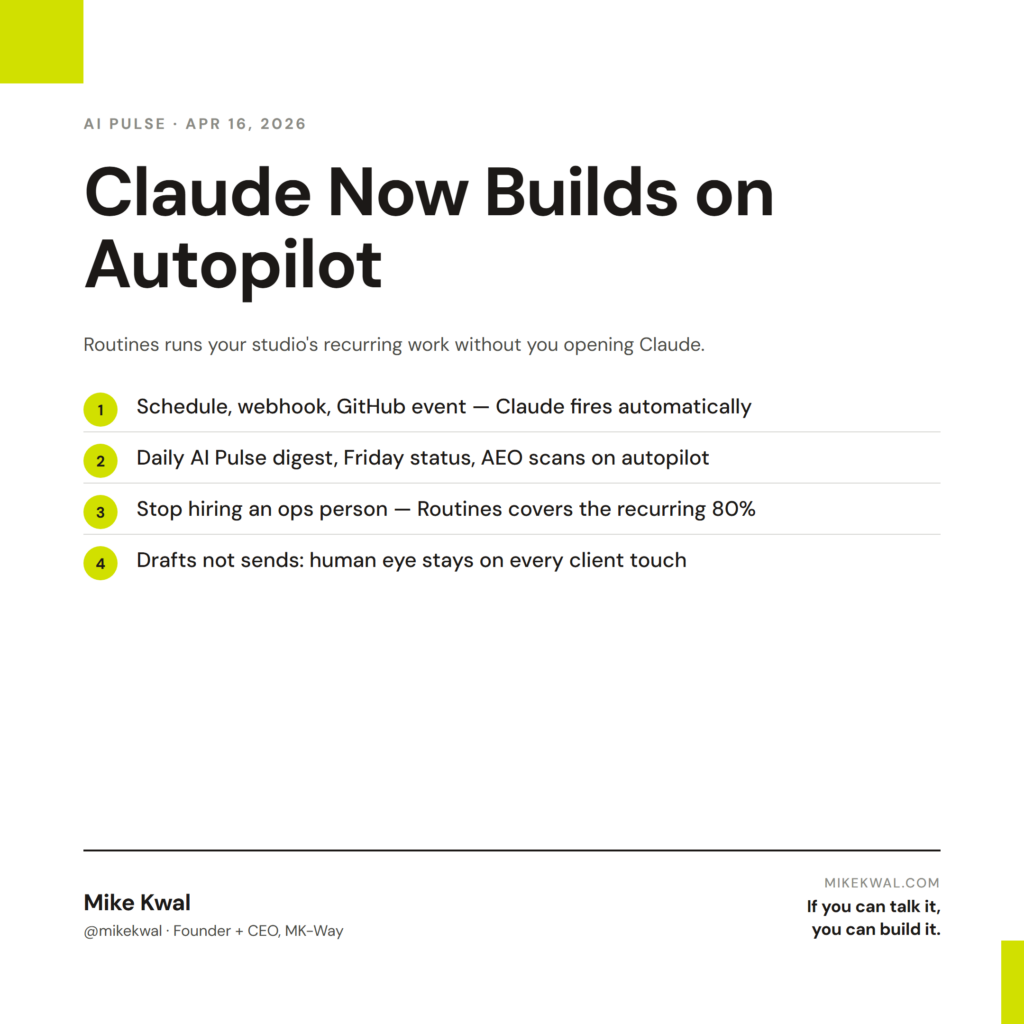
Anthropic dropped Routines inside Claude Code. Write the task once. Pick a schedule (daily, weekly), a repo (the project Claude should run on), or a trigger (webhook, API call, GitHub event). Claude runs it automatically.
Scheduled builds. Automated commits. Content pipelines that run themselves. Code reviews that fire when a pull request lands. All without you opening Claude.
This is the difference between “I have a tool I open when I need it” and “I have a teammate who handles the recurring work without me.”
Why this matters for designers
If you’re a freelance designer or run a small agency, your week has a hidden tax: the recurring small tasks that aren’t billable but you can’t drop. Friday status emails. Monthly invoice prep. Blog post repurposing. Daily AI Pulse scanning. Client report generation.
Each task takes 10–30 minutes. Together they eat 5–10 hours a week. That’s a full Saturday you don’t get back.
Routines lets you describe each task once and have Claude run it forever. The Saturday comes back.
For agencies, the lift is bigger: when every team member’s recurring tasks are automated, you stop hiring an ops person. You stop creating “we forgot to do X” backlogs. The studio runs more reliably with fewer people.
My $0.02 — How I’d actually use this
Three Routines I built that paid for themselves the first week:
Routine 1: Daily AI Pulse digest. Trigger: every weekday morning at 7 AM. Action: Claude scans my Tier 1 source list (Webflow, Anthropic, OpenAI, Wix, Shopify blogs), pulls top 3 stories, writes 30-word summaries, drops them in a Notion doc. By the time I sit down at my desk, the digest is ready. I read it with my matcha. The lift: I never miss a launch that affects website-building, which means I’m always the first person posting about it on social.
Routine 2: Friday client status drafter. Trigger: every Friday at 3 PM. Action: Claude reads each active client’s Monday.com board, writes a one-paragraph “this week” summary for each, queues them as Gmail drafts. I review and send by 5 PM. The lift: every client gets a weekly touch they didn’t have before. Retention is real money.
Routine 3: AEO scan on every new client lead. Trigger: a new GoHighLevel form submission. Action: Claude pulls the lead’s website URL, runs a 5-point AEO check, drafts a personalized email with the findings, queues it as a Gmail draft. I review and send within an hour of the lead landing. The lift: my close rate on cold leads went up because the speed of follow-up signals seriousness.
That’s three Routines. Total setup time: a Sunday afternoon. Time saved per week: easily 6–8 hours. Reclaiming that time for actual design work is where the leverage is.
What I’d avoid: don’t build Routines for tasks that touch payments or send communications without review. Every Routine I run queues to drafts, not direct sends. Human eye on every client touch. The point isn’t to remove yourself from your business — it’s to remove the boring part so you can focus on the valuable part.
The bigger lesson: AI moves you up the value chain. You stop being the person who writes the Friday status email. You become the person who reviewed and approved it. Different work. Same client. More leverage.
Want the full playbook?
For the full automation stack I run my studio on, see my Talk-to-Build Stack.
FAQ
What’s the difference between Routines and a custom-coded automation?
Routines is no-code. You describe the task. Claude generates the code under the hood and runs it. Custom-coded automations require an engineer.
How much do Routines cost?
Bundled with paid Claude plans. Usage caps based on tier. Heavy users will hit Pro limits and want Team or Max.
Can a Routine run forever?
Yes — it runs until you turn it off. The trigger fires, Claude executes, the result lands wherever you wired it.
What if my Routine breaks?
Claude alerts you in the dashboard. Build alerts into your routine itself by adding “if anything fails, post to Slack.”
Can a Routine call my CRM, Calendar, etc.?
Yes — through MCP connectors. Claude Desktop has native Slack, Gmail, Calendar, Monday.com, GitHub integrations available to Routines.
Want help applying this?
Four ways to go deeper:
- Build with Builders. Join the Talk-to-Build community to Learn how to Earn money with AI, Download our AI Skills, Advance your business, Learn to build real assets for Website Design & Shopify stores — Gen-AI images, cinematic AI videos, conversational AI office secretaries — that you can sell to SMBs that want the outcomes but don’t have time to learn the skills.
- Done-for-you. MK-Way builds AEO-ready websites and apps for design agencies and founders who want it shipped fast.
- Quick question. DM me on Instagram. I read every message.
- B2B / strategy. Connect on LinkedIn for deeper conversations about AI in design and agency work.
Last updated: May 7, 2026.