
What’s in this article
- Why “SEO is dead” is more accurate than ever in 2026.
- What Webflow AEO does — measures and fixes AI search visibility.
- The closed-loop pattern — measurement, recommendation, automatic fix.
- Why this is bigger than Webflow — every site builder will have it soon.
- How I’d actually use this on every client site I ship.
I’m Mike Kwal. I’ve been tracking the SEO-to-AEO shift since the first Google AI Overview rolled out. Webflow just shipped the most complete closed-loop AEO product I’ve seen.
What just happened
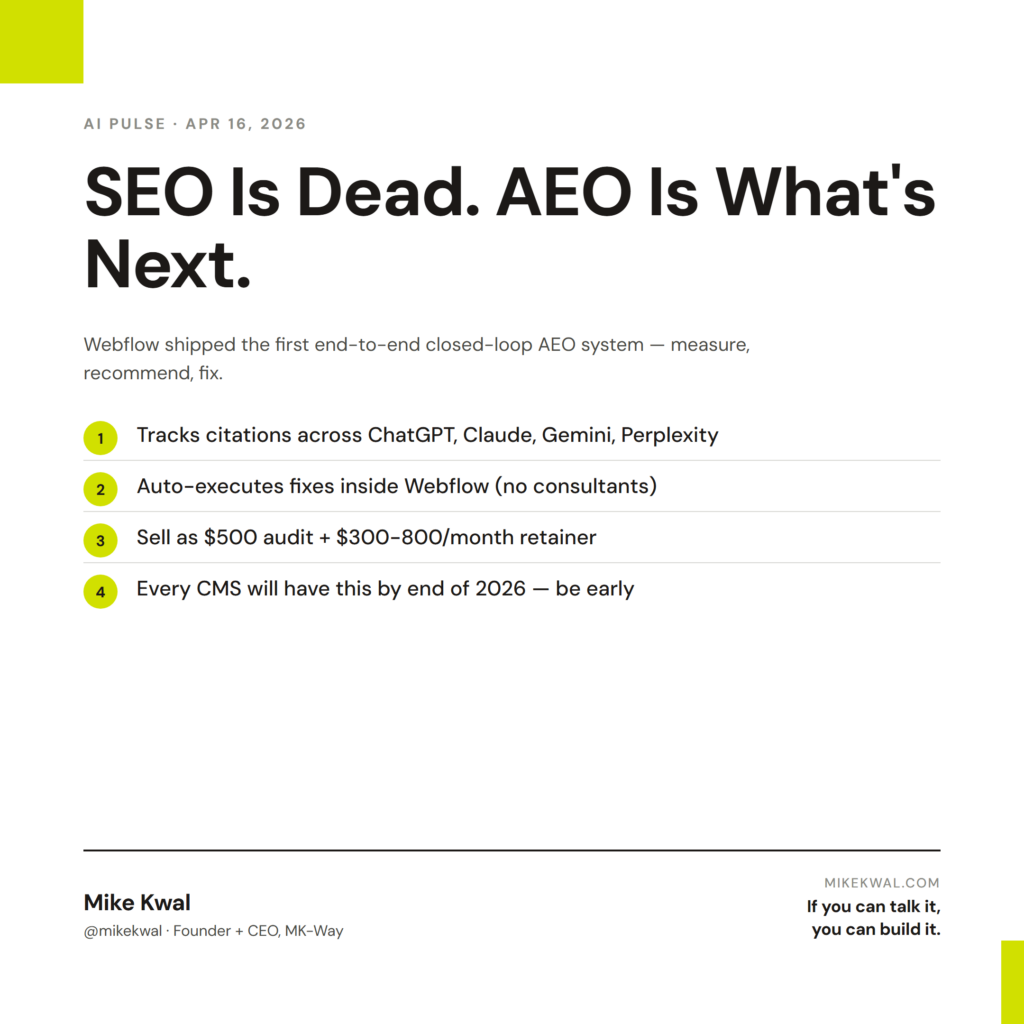
Webflow launched AEO — Answer Engine Optimization — as a closed-beta feature. The pitch: measure how often ChatGPT, Claude, Gemini, and Perplexity surface your content, identify the gaps, and automatically execute fixes inside Webflow. No manual SEO. No consultants. The system reads the problem and fixes it.
This is the first end-to-end AEO loop from a major site builder. WordPress is catching up via plugins. Wix and Shopify are working on similar features. Webflow is shipping first.
Why this matters for designers
If you’re a designer shipping client sites, AEO is now a real category — not a “nice to have.” Three reasons.
AI engines are eating Google traffic. The behavioral data is no longer hypothetical. Users are asking ChatGPT instead of Google. They get an answer; they don’t visit the site. If your content isn’t being cited by the AI, the user never finds you.
AEO is a sellable service. I’ve sold AEO audits and AEO retainers as standalone services for the last 18 months. The market is buying — clients understand that “we need to show up in ChatGPT” is the new “we need to rank on Google.”
Webflow’s closed loop is the future shape of every CMS. Today it’s Webflow. By end of 2026, WordPress (via plugins), Shopify (via apps), and Wix (native) will all have similar closed-loop AEO systems. The question for designers isn’t whether to learn AEO. It’s whether you’ll learn it before your competitors do.
My $0.02 — How I’d actually use this
If I’m shipping a Webflow site this week, here’s the AEO workflow I’d default to.
During the build: schema, structure, llms.txt baked in. I use the Webflow CMS template to ship Article schema on every blog post. I structure cornerstone pages as question-answer blocks. I drop an llms.txt file at the root with the brand’s voice and key pages. None of this slows the design work — it’s a different default for the build, not extra work.
At launch: turn on Webflow AEO and let it baseline. The first two weeks after launch, Webflow AEO measures how often the site is surfaced in AI engines. Don’t make changes during this window — let it learn what’s working and what isn’t.
Two weeks in: run the recommendations. Webflow AEO surfaces the gaps. I’d review them with the client, prioritize the top 3, and let Webflow execute the fixes automatically. The client sees an AI-search visibility score that improves week over week. This is the win you sell on.
Ongoing: monthly retainer. I sell every Webflow client a monthly AEO retainer ($300–800/month depending on site size) to keep the score climbing. The retainer pays for itself in client retention even if the score never goes up — but it always goes up.
For non-Webflow sites (WordPress, Shopify, Squarespace), the same pattern applies — schema, structure, llms.txt, monthly review — but you do it manually with a tool stack instead of native AEO. WordPress + Rank Math gets you 80% there. Shopify with native schema + Reviews app does the same.
The real lesson for designers: AEO is not a one-time setup. It’s a practice. The studios that build AEO into their default process — and sell it as a recurring service — capture market share over the studios that treat it as a one-time line item.
Want the full playbook?
For the complete AEO checklist (Webflow, WordPress, Shopify, Squarespace) — schema setup, llms.txt, content structure, FAQ blocks — see my AEO Pack.
FAQ
Is Webflow AEO out of beta?
As of this post, it’s still closed beta. Sign up for the waitlist; access is being granted in waves.
Does AEO replace SEO?
No — AEO sits on top of SEO. Most AEO signals (clean structure, schema, fast load times, real expertise) are also SEO signals. Don’t burn down your SEO; layer AEO on it.
How long until I see results?
Schema is read on next AI crawl (days, sometimes hours). Content restructuring takes 2–4 weeks to show up in AI citations. The closed-loop system in Webflow accelerates this by automating the gap-fix step.
What about my non-Webflow clients?
Same playbook, manual execution. WordPress + Rank Math handles schema and structure. Shopify has native schema. Squarespace is improving but still trails. The Webflow advantage is automation, not the underlying technique.
Can I sell AEO as its own service?
Yes — and I think you should. Audit + monthly retainer is the simplest model. Pricing varies by market; $500 audit + $300–800/month retainer is a reasonable starting point.
Want help applying this?
Four ways to go deeper:
- Build with Builders. Join the Talk-to-Build community to Learn how to Earn money with AI, Download our AI Skills, Advance your business, Learn to build real assets for Website Design & Shopify stores — Gen-AI images, cinematic AI videos, conversational AI office secretaries — that you can sell to SMBs that want the outcomes but don’t have time to learn the skills.
- Done-for-you. MK-Way builds AEO-ready websites and apps for design agencies and founders who want it shipped fast.
- Quick question. DM me on Instagram. I read every message.
- B2B / strategy. Connect on LinkedIn for deeper conversations about AI in design and agency work.
Last updated: May 7, 2026.