
What’s in this article
- What Google reported — 75% of new code at Google is AI-written.
- What “AI-written” actually means in this context.
- Why this is the strongest signal yet for designers betting on AI builds.
- What it means for the design-vs-dev hiring market.
- How I’d actually use this as proof in client conversations.
I’m Mike Kwal. I get the question every week: “Is AI really ready to build production websites and apps?” Google’s quarterly earnings call just answered that question for me.
What just happened
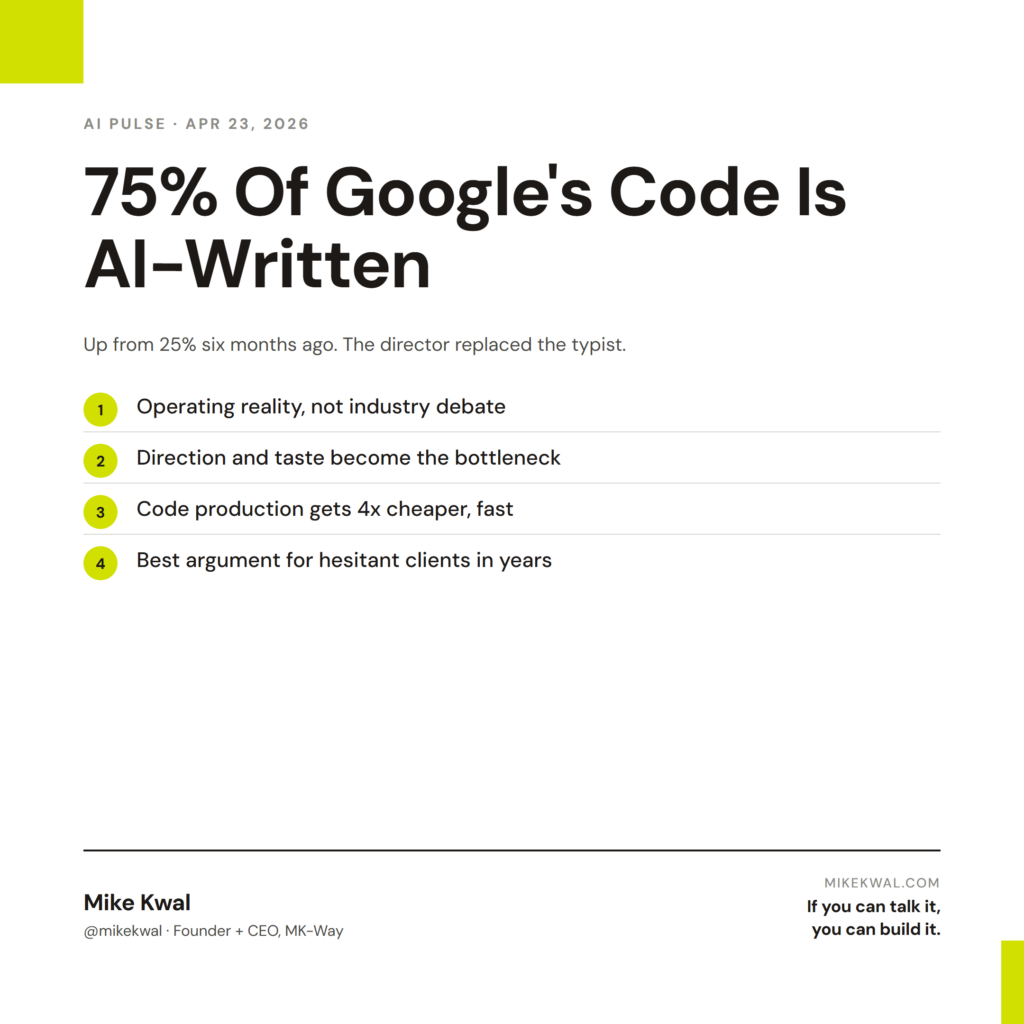
In Google’s Q1 2026 earnings call, Sundar Pichai reported that 75% of all new code at Google is now written by AI. Engineers review it and approve. The figure was up sharply from a previous 25% reported six months prior.
To translate: at the company that invented modern AI, three out of four lines of code in 2026 come from an AI agent, with a human reviewing and merging. The human is still in the loop. The human is no longer the typist.
Why this matters for designers
For designers wondering if AI is “really” ready for client work, this is the clearest possible signal.
The bar moved. When Google does it at this scale, “AI builds production code” stops being an industry debate and becomes operating reality. Every designer-developer-founder downstream of Google will follow the same pattern.
The skill that matters shifts. Up until now, the typist was the bottleneck. Now the director is the bottleneck. The person who writes the brief, reviews the output, and ships the work is the person who matters. Designers have been training for this role their whole career — direction, taste, review.
Pricing shifts. When code production gets 4x cheaper, the value of code production drops. The value of direction and taste rises. Designers who position themselves as AI-build directors will outearn designers who keep selling time.
This is also the strongest argument for clients who hesitate to trust AI-built work. “Google’s running 75% AI-written code. Your marketing site is fine.”
My $0.02 — How I’d actually use this
Here’s how I use this stat in client conversations.
In sales calls when a prospect asks “is the AI you build with reliable enough for production?” — “Google announced last week that 75% of their code is AI-written. The biggest software company in the world is shipping AI-built code at scale. Your contact form will be fine.” Conversation closed. Move to scope.
In proposals when explaining why my pricing is competitive — “My builds use AI-assisted development at every layer. That’s not a corner-cut, it’s how Google does it now. The savings get passed to you.”
In LinkedIn content when arguing that AI-built work is real work — “75% of Google’s new code is AI-written. The argument that AI builds are ‘unprofessional’ is officially over.” This is good content. People share it.
The other thing this changes: how I think about staffing my own studio. Three years ago, scaling from a one-person studio to a five-person agency meant hiring developers. Now it means upgrading my AI stack and hiring designers who are good at directing AI. Different shape. Same output.
What I’d not do: use this stat to dismiss real engineering rigor. Google’s 75% AI-written code goes through senior engineers who review every diff. The human-in-the-loop isn’t optional. It’s the design of the system. Designers who skip the review step (especially on security and integrations) will ship bugs that hurt client relationships.
The bigger lesson: when the world’s most-respected software company says “we’re 75% AI-written and shipping,” the question for designers stops being “should I use AI?” and starts being “how fast can I get good at directing it?”
Want the full playbook?
For my full AI build stack — what I run, how I direct it, what I review before shipping — see my Talk-to-Build Stack.
FAQ
Does “AI-written” mean fully autonomous?
No — engineers review and approve every change. The AI is the writer; the human is the editor and merger.
Will every company hit 75%?
Probably yes within 18 months. Google is the early benchmark, not the ceiling.
Should designers learn to code now?
Less than before. Designers should learn to review AI-generated code — read it, spot issues, ask the right questions. The typing layer is dying. The review layer is rising.
What about engineering jobs?
Junior engineers who only write code will compress. Senior engineers who direct, review, and architect will thrive. Same shape as design.
Is this a hiring signal?
Yes — design agencies should hire designers who are AI-fluent rather than developers who can’t direct AI. Different skill mix than three years ago.
Want help applying this?
Four ways to go deeper:
- Build with Builders. Join the Talk-to-Build community to Learn how to Earn money with AI, Download our AI Skills, Advance your business, Learn to build real assets for Website Design & Shopify stores — Gen-AI images, cinematic AI videos, conversational AI office secretaries — that you can sell to SMBs that want the outcomes but don’t have time to learn the skills.
- Done-for-you. MK-Way builds AEO-ready websites and apps for design agencies and founders who want it shipped fast.
- Quick question. DM me on Instagram. I read every message.
- B2B / strategy. Connect on LinkedIn for deeper conversations about AI in design and agency work.
Last updated: May 7, 2026.