

What’s in this article
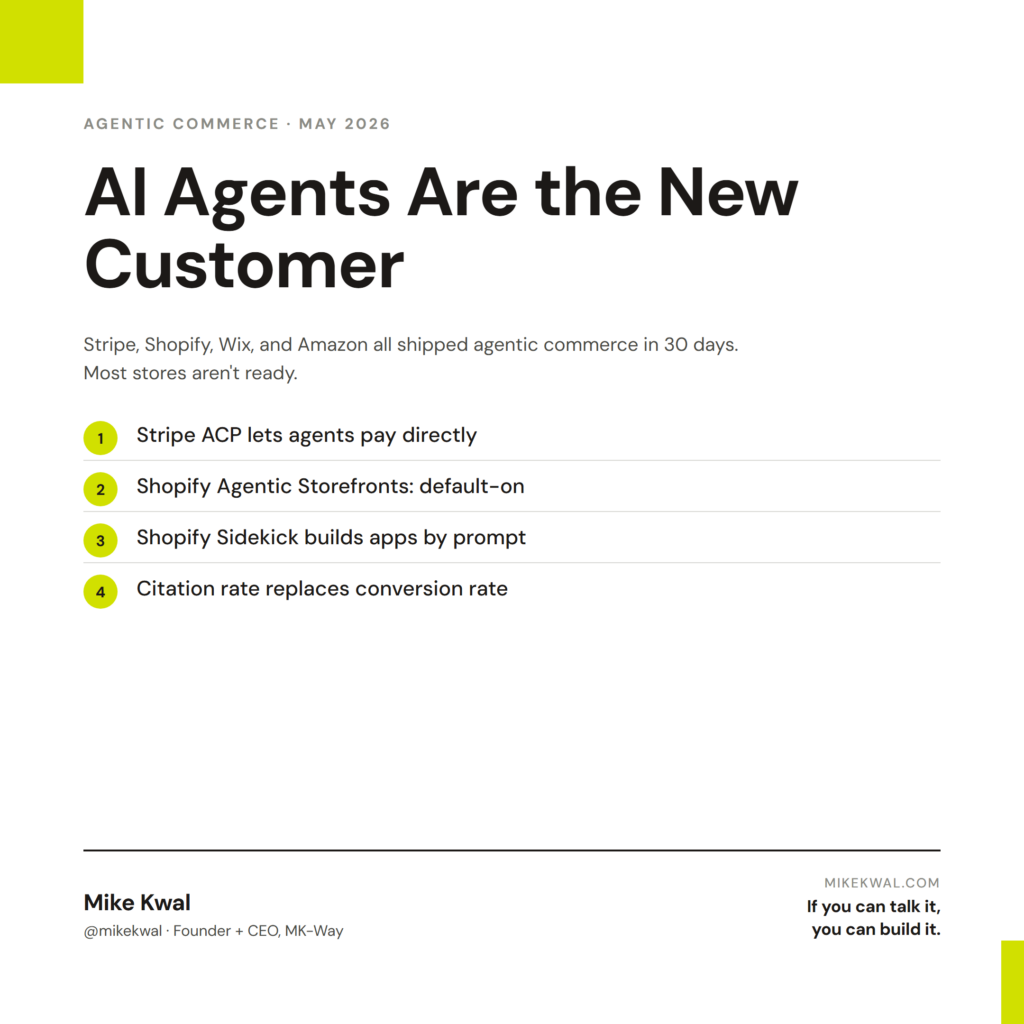
- What “agentic commerce” actually means — AI agents (ChatGPT, Claude, Gemini, Perplexity) are now the buyer, and a new shopper is at your door.
- The four shifts in 30 days — Stripe’s Agentic Commerce Protocol, Shopify’s default-on Agentic Storefronts, Wix joining ACP, and Amazon’s “Join the Chat.”
- Shopify Sidekick — describe an app, get a working Shopify app. Custom logic without a developer.
- The 8-point checklist to make your store findable, citable, and buyable by AI agents.
- What’s coming next — agent-to-agent negotiation, dynamic pricing for AI buyers, and the new metric that replaces “conversion rate.”
- What to do this week if you sell anything online — even one product.
🚀 Plug this into Claude Code or Google Antigravity
Don’t want to read all this? Get the one-click implementation pack: download the spec, drop it into Claude Code, and let it implement on your site. Includes the Shopify / Wix / Stripe ACP verification walkthrough, Product + FAQPage schema templates, AI-friendly title and description formulas, and the exact ChatGPT / Claude / Perplexity prompts to test agent visibility on your store.
Get stuck? Want hands-on Q&A, weekly office hours, or help applying this to your specific Shopify / WordPress / Webflow site? That’s what the Talk-to-Build community is for — a technical support community for designers and creative directors building with AI.
I’m Mike Kwal. I build websites every day with AI, and the way people buy online just changed in front of me. Not in a “this might happen someday” way — in a “Stripe, Shopify, Wix, and Amazon all shipped this in the same month” way.
If you sell anything online, this post is the playbook. Bookmark it.
What does “agentic commerce” mean?
Agentic commerce is when an AI agent does the buying and selling on behalf of a human.
Old way: a person opens a browser, types into Google, clicks a link, lands on your store, browses, adds to cart, fills in a form, pays.
New way: a person says to ChatGPT, “I need a new pair of running shoes for marathon training, size 10, under $180, ships to Toronto.” ChatGPT goes out, finds the right product across the web, confirms with the buyer, and pays — without ever opening your website in a browser.
The buyer in that flow isn’t a human anymore. It’s an AI agent. Your store has to be ready to talk to that agent the way it used to be ready for a human.
Three things change for store owners:
- Discovery moves off Google. AI agents don’t browse — they query.
- Checkout moves off your cart page. The agent pays directly, often inside the chat.
- Trust moves to structured data. The agent decides who to buy from based on what your site says about itself in a machine-readable way.
This is happening right now. Here’s the proof.
Stripe’s Agentic Commerce Protocol (ACP)
In April 2026, Stripe and OpenAI co-launched the Agentic Commerce Protocol (ACP) — an open standard that lets AI agents complete purchases on behalf of users without sending them off to a checkout page.
What ACP does in plain English:
- A user tells an AI agent (like ChatGPT) what they want.
- The agent finds the product on a participating store.
- The agent pays through Stripe using a delegated payment token from the user.
- The merchant gets the order. The user gets a confirmation. No checkout page involved.
Stripe handles the trust layer (it’s still a real card on file, with real fraud checks and real chargebacks). The merchant gets a normal Stripe payout. The agent gets to complete the transaction in one shot.
This is a big deal because it solves the “AI agents can’t buy things” problem at the protocol level. Before ACP, AI agents had to either fake-fill checkout forms (fragile) or hand the user back to do the last step themselves (broken UX). ACP makes the purchase the agent’s job, not the human’s.
OpenAI confirmed the Instant Checkout experience in ChatGPT runs on ACP. So if your store accepts Stripe and you opt into ACP, ChatGPT can already buy from you.
Shopify Agentic Storefronts (default-on for every store)
A few weeks later, Shopify announced Agentic Storefronts — and made it default-on for every Shopify store on the planet.
Read that twice. Default-on. If you have a Shopify store, you don’t have to opt in. AI agents can already discover and buy from you.
What Shopify rolled out:
- A dedicated agent endpoint for every store — agents query a structured catalog feed instead of scraping the storefront.
- Native ACP support — Stripe’s protocol works out of the box.
- Agent-readable product data — every product page now ships with the structured fields agents need (price, variants, shipping, returns, availability).
- Conversation-ready answers — store policies, sizing, fit, and FAQs surface as structured Q&A so agents can answer mid-conversation without the user leaving the chat.
If you sell on Shopify, your store is already a participant in agentic commerce. Whether you’re getting cited and bought from depends on how clean your product data is. (More on that below.)
Wix + ACP integration
Right after Shopify, Wix announced ACP integration for the Wix eCommerce stack. Same idea, same protocol — Wix stores can now be discovered, chatted with, and purchased from by AI agents through Stripe ACP.
The pattern is becoming clear: the platforms aren’t competing on whether to support agentic commerce. They’re racing to support it first. Squarespace, BigCommerce, and the WooCommerce ecosystem are next.
If you’re on Wix, you turn it on in your store dashboard. If you’re on a custom or headless setup, you implement ACP directly via Stripe’s docs.
If you’re on something else — and you sell online — this is your warning shot. The default for ecommerce in 2026 is “agent-ready.” If your store can’t talk to an agent, it’s invisible to a growing slice of buyers.
Shopify Sidekick: build apps by talking
Alongside Agentic Storefronts, Shopify shipped a major upgrade to Sidekick — its in-store AI assistant.
The new Sidekick can build custom Shopify apps from a prompt. You describe what you want — “I need a one-page upsell that triggers when a customer adds a $50+ item to cart, and shows them the matching add-on with a 15% discount” — and Sidekick generates a working Shopify app for your store.
Why this matters:
- You don’t need a developer for custom store logic anymore. Most “I wish my store did X” requests now take five minutes instead of five weeks.
- Apps are written in your store’s voice and brand. No more bolted-on third-party look.
- The agent loop closes. AI agents shop your store. Sidekick builds the experience the agents shop. You’re orchestrating both sides from one prompt window.
This is the same shift I keep talking about. If you can talk it, you can build it. Shopify just made that true for store owners who never wrote a line of code.
Amazon “Join the Chat”
Amazon answered with Join the Chat on May 1 — conversational AI on every product page, both voice and text.
What it does:
- A shopper opens a product page on Amazon.
- They tap the chat button (or talk to it).
- They ask anything — “will this fit a queen bed,” “how loud is it actually,” “is this the same as the 2024 model” — and get an answer pulled from the listing, the Q&A, the reviews, and Amazon’s own data.
Two things to notice:
- Amazon is training shoppers to ask, not browse. The expectation that AI answers product questions instantly is now the default. When a shopper hits your store next, they expect the same thing.
- The product page is now a conversation. Static copy isn’t enough. Your listing has to answer questions the way Amazon’s chat does — or it loses.
If you sell on Amazon, optimize your listing for AI Q&A: clear bullets, complete attributes, accurate Q&A section, structured reviews. If you don’t sell on Amazon, the lesson still applies — your own product pages have to be conversation-ready.
How to optimize YOUR store for AI agents (the practical checklist)
This is the part you actually do. Eight steps. In order.
1. Add structured product data (Schema.org Product)
Every product page needs Product schema as JSON-LD in the <head> — name, description, image, SKU, brand, offers (price, currency, availability), aggregateRating, review. AI agents read schema before they read your prose. If it’s missing, you’re invisible.
Test it: paste your product URL into Google’s Rich Results Test. Anything green = agents can read it.
2. Add an llms.txt file at your root
llms.txt is the AEO equivalent of robots.txt — it tells AI engines what your store is, what you sell, and where the important pages live. Drop it at https://yourstore.com/llms.txt. (See my AEO playbook for the exact template.)
3. Turn on agent commerce on your platform
- Shopify: already on by default. Confirm in Settings → Markets → Agent Commerce.
- Wix: Dashboard → eCommerce → Agentic Commerce → toggle on.
- WooCommerce/custom: implement Stripe ACP directly via the Stripe ACP docs.
4. Make every product page answer the top 10 questions
If a shopper or an agent has to leave the page to find sizing, shipping, returns, materials, dimensions, compatibility — you lose. Put the answers on the page in a structured FAQ block (with FAQPage schema). This is what agents extract and quote when they recommend you.
5. Clean your product titles and descriptions for AI parsing
Agents do better with structured language. Lead with what the product is, then what it does, then who it’s for. Avoid clever marketing one-liners as product titles. “Crushable Sun Hat — Packable, UPF 50, Women’s S–L” beats “Summertime Vibes ☀️” every time.
6. Publish your policies in plain language
Returns, shipping, warranty, sizing — pull these out of your footer and onto a clean policies page with clear headings. Agents quote policies when buyers ask. Vague policies = lost trust = no purchase.
7. Add real reviews with structured review schema
Review and AggregateRating schema on every product. Agents weight social proof heavily — they cite ratings before they cite copy. If you have reviews on Trustpilot, Google, or your platform, surface them on the product page with schema.
8. Test agent visibility weekly
Once a week, ask an agent: “Best [your category] under [your price] that ships to [your market].” Are you mentioned? If yes, what did the agent say about you? If no, what got cited instead? Reverse-engineer the winners and improve.
The old metric was conversion rate — how many humans who landed on your page bought. The new metric is citation rate — how often an AI agent recommends or buys from you when a human asks. Same goal. Different audience.
What’s coming next
Three patterns I’m watching:
Agent-to-agent negotiation. Buyer’s agent talks to seller’s agent. Price, terms, delivery, bundle deals — negotiated in milliseconds. Stripe’s ACP already supports basic delegated authority. Full negotiation is months away, not years.
Dynamic pricing for AI buyers. Agents will request a quote, not a price tag. Stores will respond with offers tuned to the buyer’s stated needs. This is already normal in B2B. It’s coming to D2C.
Agent reputation systems. Just like a human shopper has reviews of stores, agents will have reviews of stores too — based on how cleanly the order completed, how accurate the data was, how easy returns were. Bad agent UX = lower rank in agent search. Build for both audiences from day one.
The takeaway: agentic commerce isn’t a feature. It’s the new substrate. Stores that treat it as a checkbox in Q4 will be behind stores that treat it as the foundation in Q2.
My $0.02 — How I’d actually optimize a Shopify/Wix store for AI agents
If I’m taking a Shopify or Wix client store live this month, here’s exactly what I’d do — start to finish — to make it AI-agent-friendly. Three days. No developer required.
Day 1 — Audit and verify (90 minutes)
I’d open the top five product pages and read them out loud. If I can’t answer “what is it, what’s it for, who’s it for, what’s it cost, when does it ship” in the first scroll, I’d rewrite. AI agents extract answers in that order — if a human can’t find them quickly, an agent won’t either.
Then I’d verify the platform is actually agent-ready:
- Shopify: Settings → Markets → Agent Commerce. It’s default-on, but I’ve seen client stores where someone toggled it off “to be safe.” I’d confirm it’s live, then check the agent feed renders at
yourstore.com/.well-known/agentic-commerce(or the equivalent on your theme). - Wix: Dashboard → eCommerce → Agentic Commerce. One toggle. Flip it on if it isn’t.
- Not on Shopify or Wix? I’d wire up Stripe ACP directly using Stripe’s docs. It’s a half-day for a developer, and it future-proofs the store.
Day 2 — Restructure the product page (3 hours)
I’d rebuild every product page around a structured FAQ block. Eight to ten questions per product, real answers, FAQPage schema in JSON-LD. The questions I always include: sizing, materials, shipping cost and time, returns window, warranty, compatibility, “what’s in the box,” and “who is this for.” Agents quote FAQ blocks verbatim — this is the single highest-leverage change a designer can make in an afternoon.
While I’m in there, I’d clean the product titles. “Crushable Sun Hat — Packable, UPF 50, Women’s S–L” beats “Summertime Vibes ☀️” every time. Lead with what it is. Save the brand voice for the hero image and the lifestyle shot.
Day 3 — Test agent visibility (45 minutes)
I’d open ChatGPT, Claude, and Gemini and ask each one: “Where can I buy [client’s product] under [client’s price] that ships to [client’s market]?” If the client’s store doesn’t appear, I’d look at who did, paste their product URL into the Rich Results Test, and reverse-engineer their schema. Then I’d run the same test weekly for the first month.
That’s the whole loop. Most designers I know are still optimizing product pages for human conversion — and that work isn’t wasted, but it’s now table stakes. The new game is making the same page legible to an agent. Same page, two audiences. If you can ship that, your client’s store doesn’t go invisible the day their best customer starts shopping through chat.
FAQs
Do I need a Shopify or Wix store to participate in agentic commerce?
No. ACP is an open protocol — any store on Stripe can implement it. Shopify and Wix just made it one-click. If you’re on WooCommerce, BigCommerce, or a custom build, you implement ACP via Stripe’s docs.
Will agentic commerce kill my SEO traffic?
Some of it, yes. The same way Google’s AI Overviews already pull traffic out of the search results page. The fix is the same as AEO: be the source the agents cite, not the page that gets skipped.
Do AI agents see my ads?
Mostly not. Agents bypass ad units. The buyers most likely to use agents are also the buyers least likely to click ads. Shift budget into product data, schema, content, and reviews — the inputs agents actually weight.
What if I don’t trust AI agents to buy things?
You don’t have to trust them. The buyer does. Your job is to make your store ready for the buyers who already do. ChatGPT alone passes 800M+ weekly active users — a meaningful chunk of them are already shopping through chat.
Is this just for big brands?
The opposite. Agents optimize for the best answer, not the biggest brand. A small store with clean schema, real reviews, and an honest policies page often beats a Fortune 500 site with messy product data. This is the same opportunity small businesses got with early SEO — except faster.
How do I know if an agent already bought something from me?
Stripe tags ACP transactions in the dashboard. Shopify shows agent orders separately in the orders feed. Watch those — they’re the early signal of the channel growing.
What’s the one thing I should do this week?
Add Product and FAQPage schema to your top-selling product page. That single change makes that one page agent-readable. Then repeat for the next ten products.
Want help applying this?
Four ways to go deeper:
- Build with Builders. Join the Talk-to-Build community to Learn how to Earn money with AI, Download our AI Skills, Advance your business, Learn to build real assets for Website Design & Shopify stores — Gen-AI images, cinematic AI videos, conversational AI office secretaries — that you can sell to SMBs that want the outcomes but don’t have time to learn the skills.
- Done-for-you. MK-Way builds AEO-ready websites and apps for design agencies and founders who want it shipped fast.
- Quick question. DM me on Instagram. I read every message.
- B2B / strategy. Connect on LinkedIn for deeper conversations about AI in design and agency work.
This post is part of the AI Pulse Asset Pack series. Every video I publish on AI development gets archived here as a permanent, evergreen resource. If you commented “SELL,” “STOREFRONT,” “CHAT,” or “SIDEKICK” on one of my videos — this is the playbook. Bookmark it, share it, and check back: I update this every time agentic commerce shifts.
Last updated: May 7, 2026.