
What’s in this article
- What Fortune reported — Anthropic silently reduced Claude’s default effort.
- What that means in practice — more shortcuts, less reliability.
- The prompt structure I use to fight back — explicit step-by-step instructions.
- How to test if your AI tool is degraded.
- How I’d actually use this to protect my client work.
I’m Mike Kwal. I run my whole studio on Claude. So when reports surface that the model I depend on quietly got dumber — that’s something I take personally.
What just happened
Fortune reported that Anthropic secretly lowered Claude’s default effort level to reduce compute costs. The internal mechanism: Claude’s “thinking time” on each request was trimmed. Power users started noticing the model skipping steps, taking shortcuts, and failing on multi-step workflows.
Anthropic didn’t announce the change. They didn’t email customers. The behavioral shift only surfaced because heavy users on Reddit and Twitter started comparing notes — and then Fortune broke the story.
This is a quiet but significant moment in the AI tool market: the company you bet on can change the product underneath you without telling you.
Why this matters for designers
Three things matter here.
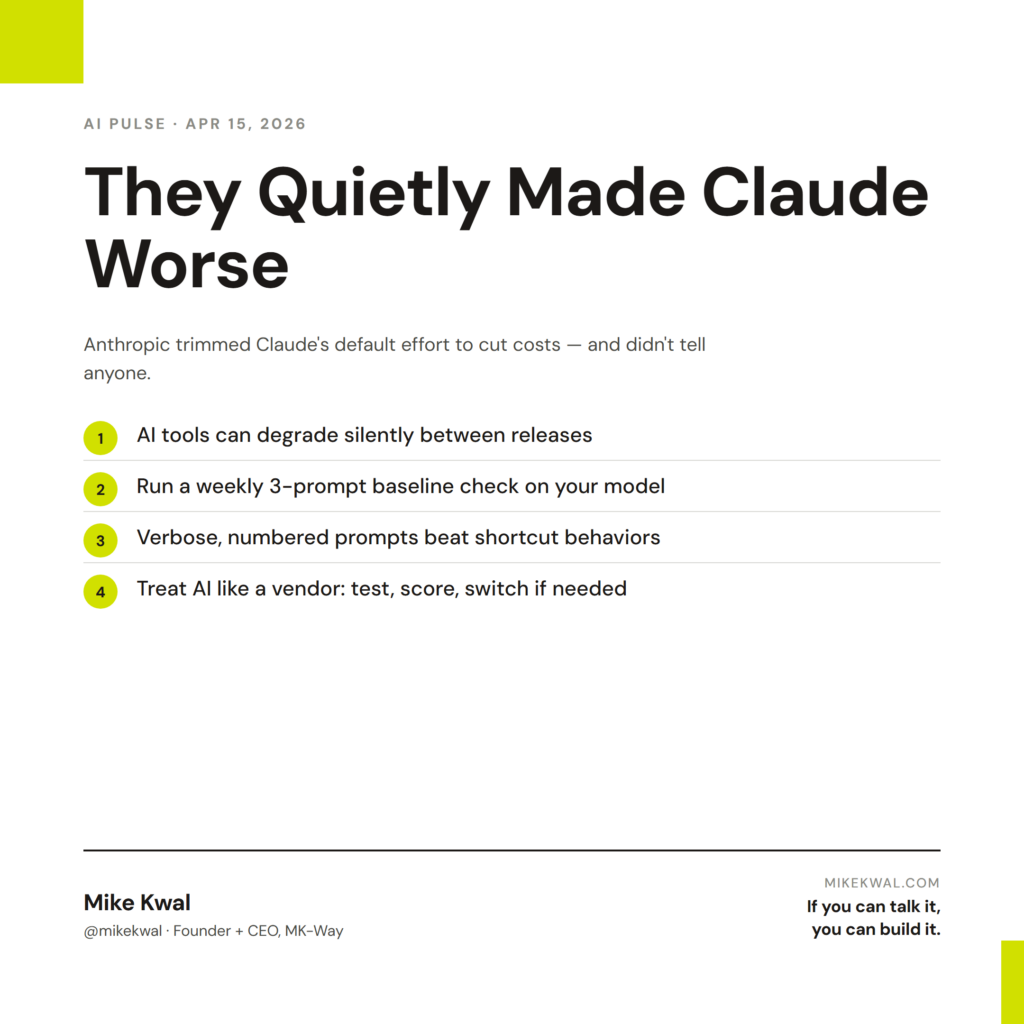
AI tools can degrade silently. Unlike a software update with release notes, model behavior changes can ship invisibly. The Claude you used last month might not be the Claude you’re using today — even if the version number didn’t change.
You should test, not trust. If you’ve been getting good output for months, you might not notice a slow drift toward worse output. Building a quick “test prompt” you run weekly to check baseline performance is now a real habit worth having.
Explicit prompts protect against shortcuts. The fix Anthropic is pushing back on: when you tell Claude exactly what to do step by step, it’s harder for the model to skip steps. The prompt-engineering era didn’t end. It got more important.
For designers paying $20–200/month for Claude, this is a “trust but verify” moment. Trust the company. Verify the output.
My $0.02 — How I’d actually use this
Here’s the prompt structure I switched to after this story broke. It’s not pretty. It’s explicit. It works.
Old prompt (what most designers write):
“Build me a contact form for my Webflow site that posts to GoHighLevel.”
New prompt (what I write now):
“Build a contact form for my Webflow site. Follow these steps in order:
- Read the existing form components in the codebase to match the style.
- Plan the data flow: form → my serverless function → GoHighLevel API.
- Write the HTML form with proper labels and validation attributes.
- Write the serverless function that handles the POST request.
- Add error handling for the GoHighLevel API call.
- Test that all input fields validate correctly before submission.
- Confirm with me before deploying.
Do not skip any step. Show me what you did at each step.”
The new prompt is verbose. It also catches every shortcut Claude would otherwise take. The output quality difference is large enough that I’d rather write 10x the prompt and get reliable code than write a short prompt and ship a bug.
The other habit I built: a weekly “baseline check.” Every Monday I run the same 3-prompt test on Claude and rate the output. Did it follow instructions? Did it complete every step? Did the code run without modification? If two weeks in a row the score drops, I switch to a different model for high-stakes client work and let the issue surface.
For designers and small agencies, this is the cost of running on a single AI tool: you have to act like a tool evaluator, not just a tool user. Five minutes a week is enough to catch a degradation before it ships into client work.
The bigger lesson: AI tools are vendors, not magic. Treat them like vendors. Test their work. Hold them to a quality bar. Switch when the bar drops.
Want the full playbook?
For the full prompting framework I use across Claude Code, Claude Desktop, and Claude.ai — and the alternate stack I switch to when needed — see my Talk-to-Build Stack.
FAQ
Did Anthropic confirm Fortune’s report?
They acknowledged the behavior change but framed it as part of normal model tuning. The community read it as a degradation; Anthropic framed it as optimization.
Has Claude been restored to full effort?
Anthropic announced fixes in mid-April. The community sentiment is “mostly back to normal” but the trust gap is still real.
Should I switch to ChatGPT?
Not over one event. But running both side-by-side on hard tasks lets you catch this kind of drift across either tool.
How do I know if my prompt is too short?
If Claude skips steps you assumed it would do, your prompt was too short. Add explicit steps. Add “do not skip” language.
Does this affect Claude Code differently?
Claude Code uses the same model under the hood. Same risk. Explicit step-by-step prompts protect against the same shortcut behaviors.
Want help applying this?
Four ways to go deeper:
- Build with Builders. Join the Talk-to-Build community to Learn how to Earn money with AI, Download our AI Skills, Advance your business, Learn to build real assets for Website Design & Shopify stores — Gen-AI images, cinematic AI videos, conversational AI office secretaries — that you can sell to SMBs that want the outcomes but don’t have time to learn the skills.
- Done-for-you. MK-Way builds AEO-ready websites and apps for design agencies and founders who want it shipped fast.
- Quick question. DM me on Instagram. I read every message.
- B2B / strategy. Connect on LinkedIn for deeper conversations about AI in design and agency work.
Last updated: May 7, 2026.